

22 Weeks Pregnant: Your Baby Is Learning the Shape of Itself
Last week, your baby was tasting your dinner. This week, your baby reaches out with brand new hands and begins to explore, touching its face, holding the cord, and slowly learning the shape of its...
Reviewed by Courtney Garland, NICU Registered Nurse, IBCLC Lactation Consultant and Paediatric Sleep Consultant
Last week, your baby was tasting your dinner. This week, your baby reaches out with brand new hands and begins to explore, touching its face, holding the cord, and slowly learning the shape of its own small self.
Welcome to week twenty-two. Your baby has become a curious little explorer, wrapped in the constant sound of you, and looking more and more like the baby you will one day hold. Let me show you.
Your baby is learning the shape of itself
Long before your baby could see or hear a thing, before any of the other senses switched on, there was touch. It was the very first sense your baby ever had, all the way back in the early weeks. And this week, your baby puts it to wonderful use.
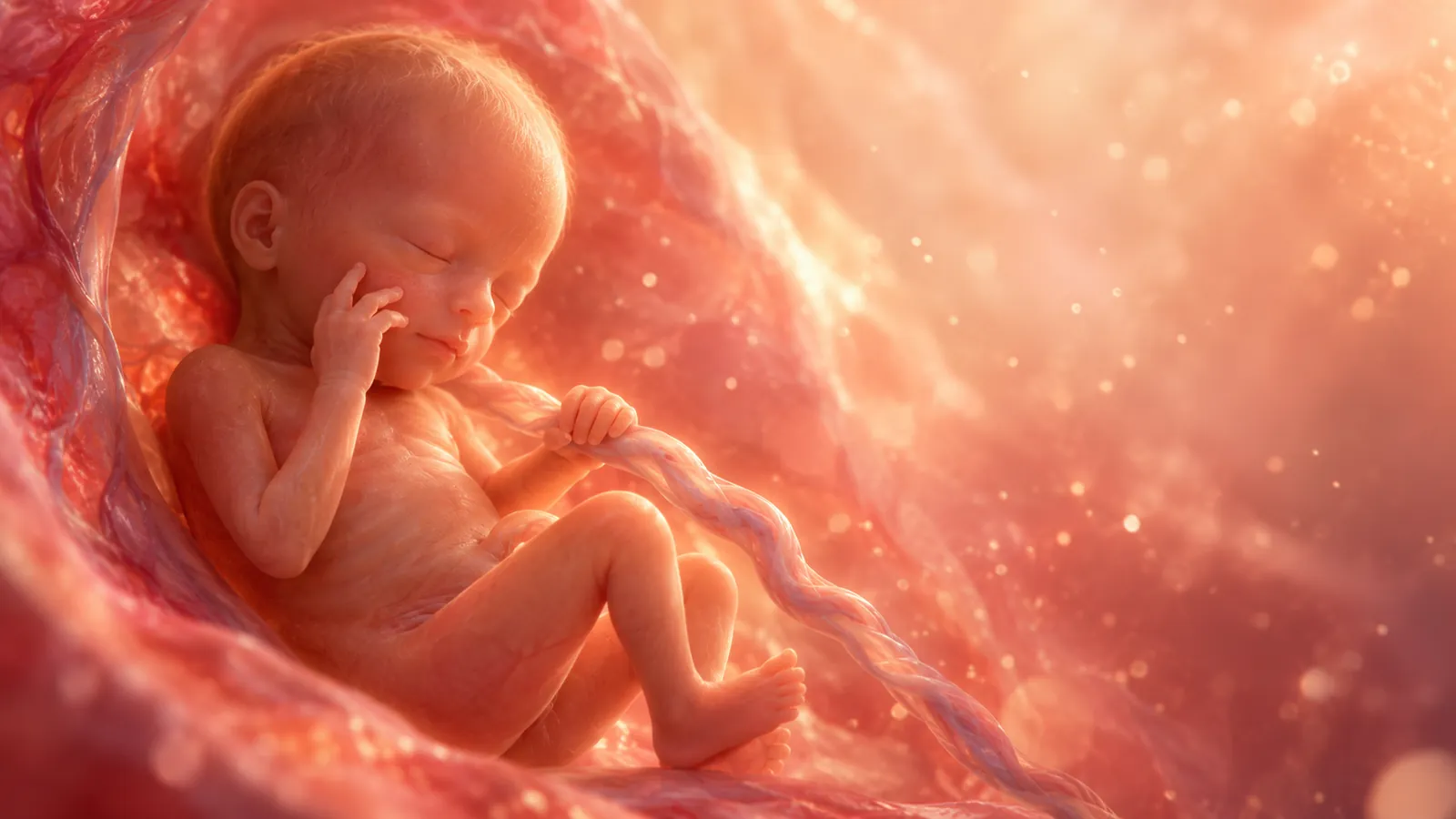
With a grip that grows stronger by the day, and a finely tuned sense of touch all over the body, your baby has become a real little explorer. Watch on a scan and you might catch it happening. A hand drifting up to stroke its own face, which is the favourite, since the face is the most sensitive part of all. One tiny hand finding and holding the other. Fingers closing around the umbilical cord, that sturdy, jelly-cushioned rope, perfectly safe to grip and tug. Feet pushing off against the soft walls of the only home your baby has ever known.
And here is the quiet wonder of it. Through all this touching and exploring, your baby is beginning to learn the shape of itself. Where its own body ends and the world begins. Researchers believe these gentle, self-directed touches are how your baby maps its own body, soothes itself, and lays down some of the earliest pathways in its growing brain. Your baby is not simply floating in there. Your baby is, in the softest and most patient way, getting to know themselves.
A world of sound around them
Your baby is wrapped in sound now too.
The hearing that switched on a few weeks ago is sharper this week, and your baby's days and nights are filled with the muffled music of you. The steady thud of your heartbeat. The whoosh of your blood. The gurgle and rumble of your tummy. The slow tide of your breathing. And, threaded through all of it, your voice. Some mothers even notice their baby give a little bounce when they laugh, the whole cosy world giving a happy shake.
Looking like a tiny newborn
Your baby looks more and more like the little person you will meet.
The eyebrows and eyelashes are in, the lips are fully formed, and there are proper fingernails on those exploring fingers. The eyes are completely formed, though their final colour is still a secret being kept for the big day. And your baby is sleeping a great deal now, twelve to fourteen hours a day, in cycles. Those long quiet spells when you feel nothing at all? Your baby is very probably fast asleep.
How big is my baby at 22 weeks?
Around twenty-eight centimetres now, head to heel, and roughly four hundred and fifty grams. Your baby is long and slender still, with plenty of soft fat to gain in the months ahead, but looking unmistakably like a baby now.
Strong enough to grip, busy enough to explore, and growing more capable by the day.
What is happening in my body?
You are very likely feeling your baby move regularly now, and starting to learn their patterns, the busy spells and the long, still stretches of sleep.
Your bump is growing steadily, and you may begin to feel the odd tightening across it, a painless, practice squeeze called a Braxton Hicks contraction, as your uterus quietly rehearses for the work ahead. It is completely normal, though it is always worth mentioning anything that worries you to your midwife or doctor.
From Courtney. There is something about this one that really stays with me. Your baby, alone in the warm dark, reaching out with brand new hands to touch their own face, to hold the cord, to feel the soft walls of the only home they have ever known. Not restless, not distressed. Just exploring, learning themselves, soothing themselves, the way they will one day suck a thumb or stroke the satin edge of a blanket. And those very hands, the ones mapping their own little face this week, are the same hands that will one day grip your finger, pat your cheek, and reach up to be held. They are practising for you, without even knowing yet that you are there. Soak this week up, mama. Your baby is busy becoming themselves.
The one thing to do this week
This week, the next time you feel your baby having a wakeful, wriggly spell, try gently resting both hands on your bump for a while. There is no right way to do it. Just a warm, still pair of hands, saying I am here. Some mothers feel their baby settle or shift toward the warmth, others feel nothing in particular, and both are perfectly fine. It is simply a quiet moment of hello, the very beginning of comforting one another by touch.
And whenever you need it, rest those hands, and the rest of you too. You are allowed.
Coming up in week twenty-three
Next week, your baby crosses a quiet but profound threshold. Their lungs begin the long, careful work of getting ready to breathe air one day, and your baby grows stronger, rounder, and more ready for the world with each passing day. It is a reassuring milestone, and a deeply hopeful one.
Week twenty-three is a week of real, growing strength. I will see you there.
The Mama Years. 2026.
You might also like

21 Weeks Pregnant: Your Baby Is Already Tasting Your Dinner
Last week, you reached the halfway mark. This week, your baby does something that will make you smile every time you sit down to eat. Your baby starts tasting your dinner.

23 Weeks Pregnant: Getting Ready for the First Breath
Last week, your baby was busy learning the shape of itself by touch. This week, deep inside that growing little body, the lungs begin one of the most important projects of all. Getting ready to...
20 Weeks Pregnant: Halfway There, and Carrying Three Generations at Once
Last week, you may have felt your baby move for the very first time. This week, you reach the middle of it all. The halfway mark. And it comes with one of the most staggering facts in the whole of...
Want to keep following your pregnancy week by week?
Track your pregnancy, follow your baby’s development and find support for the questions that come up along the way in The Mama Years.
Open The Mama Years