

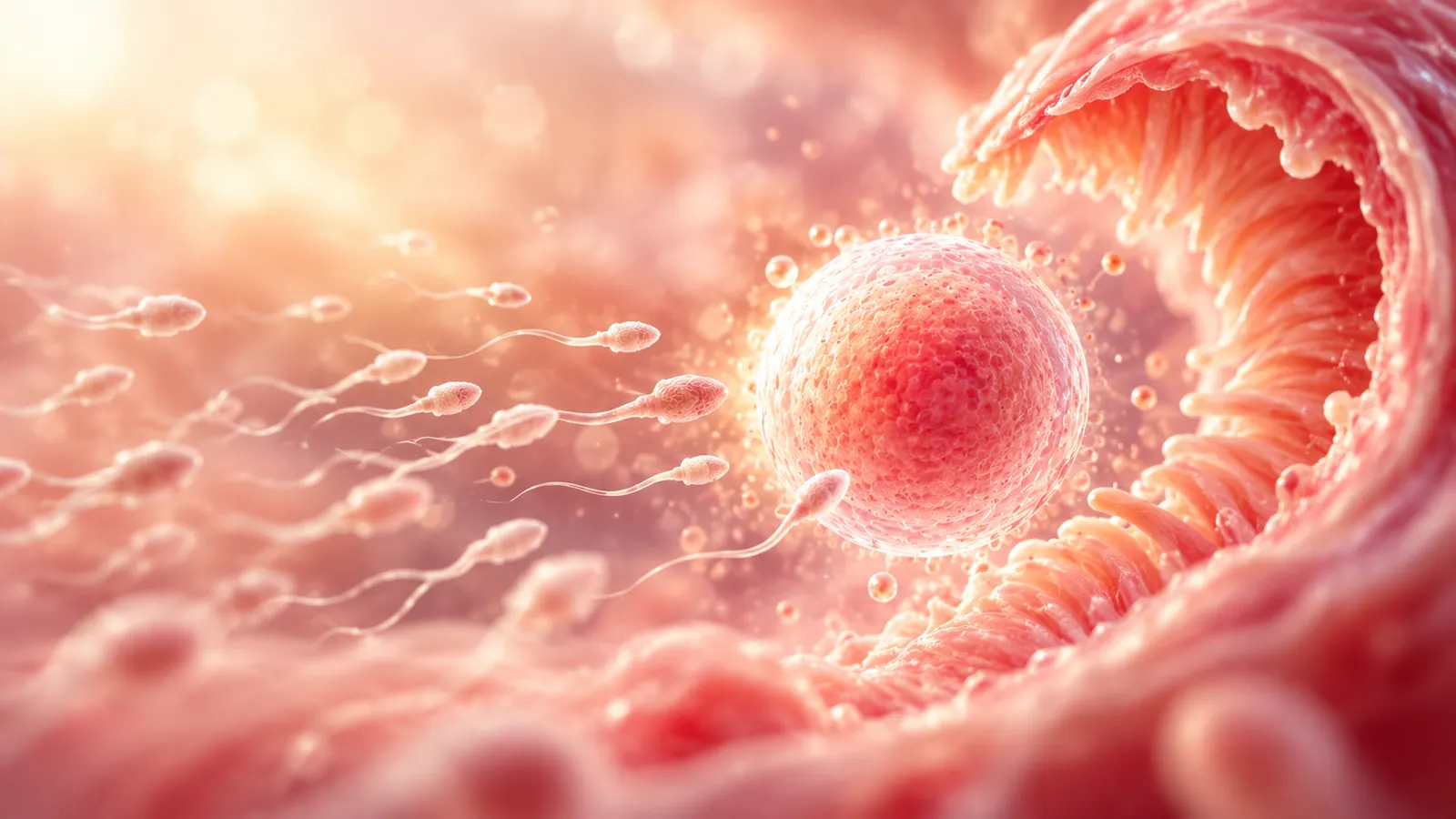
2 Weeks Pregnant: The Greatest Race You Will Never See
Last week, the egg waited. This week, it is finally set free, and the most extraordinary race in all of nature begins.
Reviewed by Courtney Garland, NICU Registered Nurse, IBCLC Lactation Consultant and Paediatric Sleep Consultant
Tens of millions of racers. One tiny egg. A single winner. And all of it playing out in silence, deep inside you, while you go about an ordinary week with no idea it is happening.
Let me show you. Honestly, most women never find out, and it is wild.
First, the egg is released
Somewhere around the middle of your cycle, your body gives a single silent signal, and one ovary lets go of the egg it has spent the whole month ripening.
This is ovulation, and here is the part that genuinely amazed me. The fallopian tube does not just sit there and wait for the egg to arrive. Its open end is fringed with soft, finger-like fronds called fimbriae, and the moment the egg is released, they reach out toward the ovary, sweep gently across its surface, and catch it. Then tiny hairs lining the tube waft it slowly inward, hand over hand, deeper inside you.
Your body does all of this entirely on its own, with a precision that no machine we have ever built can match.
And now the clock starts. The egg has about a day, maybe a little more, to meet a sperm. After that, the window quietly closes until next month. So this is the moment. If it is going to happen, it happens now.
And here is the wild part: no one had ever watched it happen
Ovulation is the event that makes every human being who has ever lived. It happens around four hundred times in a woman's life. And yet, until 2024, no scientist had ever filmed the whole thing from start to finish.
That year, a team led by Professor Melina Schuh at the Max Planck Institute in Germany finally managed it, watching the entire process unfold in real time. So far it has only been captured in tiny follicles from mice, not in a human body, but it is the closest look we have ever had at how an egg is actually set free. They could see it happen in three clear stages. The follicle swells. Then it squeezes. Then it opens, and lets the egg go.
We have mapped the ocean floor and landed robots on Mars, and we only just got to watch this. Something your own body may be doing this very week.
Then comes the race
Here is where it becomes almost unbelievable.
When the sperm arrive, there are not a handful of them. There are tens, often hundreds, of millions, and every last one is swimming for the same single egg.
The distance ahead of them is only about the length of your forearm. That sounds like nothing, until you shrink yourself down to the size of a single sperm. At that scale, it is an open ocean. You are swimming across it in the dark, with a couple of hundred million others thrashing and jostling on every side, no map, no light, no one to tell you which way to go.
And the route is brutal, by design. It is acidic enough to stop most of them where they swim. It is choked with mucus that all but the strongest cannot push through. The final doorway is so narrow that only a few can squeeze past at all. Your body built it exactly this way, on purpose, filter after filter after filter, so that only the very fittest ever reach the egg at the end.
Of the hundreds of millions that set off, only a few hundred make it anywhere close.
And of those few hundred, after everything, only one will win.
Just one. Out of a number so large you could not count it in a day. And that one is about to become half of your baby.
And then, the winner reaches the egg
So picture it. After that impossible journey, one single sperm pulls clear of all the others and reaches her at last. The egg that has waited inside you since before you were born, met by the one cell, out of hundreds of millions, that made it the whole way.
It presses against the surface. It is about to break through.
And what happens in the very next heartbeat is, to me, the single most beautiful moment in all of human biology. Your baby's life is about to begin, and it begins in a way you would genuinely never believe.
But that moment, the one where everything changes, belongs to next week.
While we wait for it, here are the questions that are probably running through your mind right now.
So why am I "2 weeks pregnant" when I have not even conceived?
Good question, and it trips everyone up.
Your pregnancy is counted from the first day of your last period, not from the day you conceive. That is simply the one date your body can be sure of. So this week you are ovulating, conception itself comes in the days just after, and yet the calendar already calls you about two weeks pregnant.
It feels back to front, because it is. But it is the way every doctor and midwife in the world counts, so it is worth knowing.
Can a test tell me anything yet?
Not yet, and here is why.
A pregnancy test looks for a hormone your body only starts making after the tiny new cell settles into your womb, and that is still a week or so away. Test now, and it will say no, even if the most extraordinary thing has just happened inside you.
So if you are waiting, waiting is the right call. Your body is not ready to show its hand just yet.
Is it normal to feel nothing? Or a little twinge?
Both are completely normal.
Most women feel nothing at all when they ovulate. Some feel a small, one-sided ache low down, which has a lovely old name, mittelschmerz, and it is simply the egg being released. You might also notice clear, stretchy discharge, a bit like raw egg white, in the days around now. That is your body's quiet signal that this is your most fertile time.
None of it feels like "being pregnant" yet, because the hormones that cause those feelings have not arrived. Feeling totally normal this week is exactly right.
From Courtney. I think the reason this week moves me so much is that it happens to women everywhere, all the time, completely unseen. While you answer emails, fold tiny washing, or lie awake hoping, your body could be running the most dramatic event in all of nature and not giving you a single clue. We spend so long feeling like our bodies are letting us down or keeping secrets from us. But this week, your body might be doing something flawless and astonishing, quietly, on your behalf. I find that worth pausing on.
The one thing to do this week
If you are taking a folate supplement, keep it going. And if you are trying for a baby and have not started one yet, this is a lovely week to begin, because folate matters most in these very earliest weeks.
If you are trying for a baby, this is your week, so know your window. Ovulation usually lands about 12 to 16 days before your next period, not automatically on day 14, because real cycles vary far more than the textbook lets on. The two or three days leading up to it are your most fertile, because sperm can wait inside you for several days, ready for the egg to arrive. That stretchy, egg-white discharge is your green light.
And if you are reading this looking back, already pregnant, you do not need to change a thing. You were exactly where you needed to be.
Coming up in week three
Next week, we pick up at the exact moment we left off. That one winning sperm breaks through, and in that instant, your baby's life begins with a real flash of light, something scientists only managed to capture in a human egg for the first time in 2016.
Then that brand new cell starts to divide, two, then four, then more, drifting slowly down toward your womb. And somewhere in that journey, it might quietly split into two whole babies.
Week three is where it all truly begins. I will see you there.
The Mama Years. 2026.
You might also like
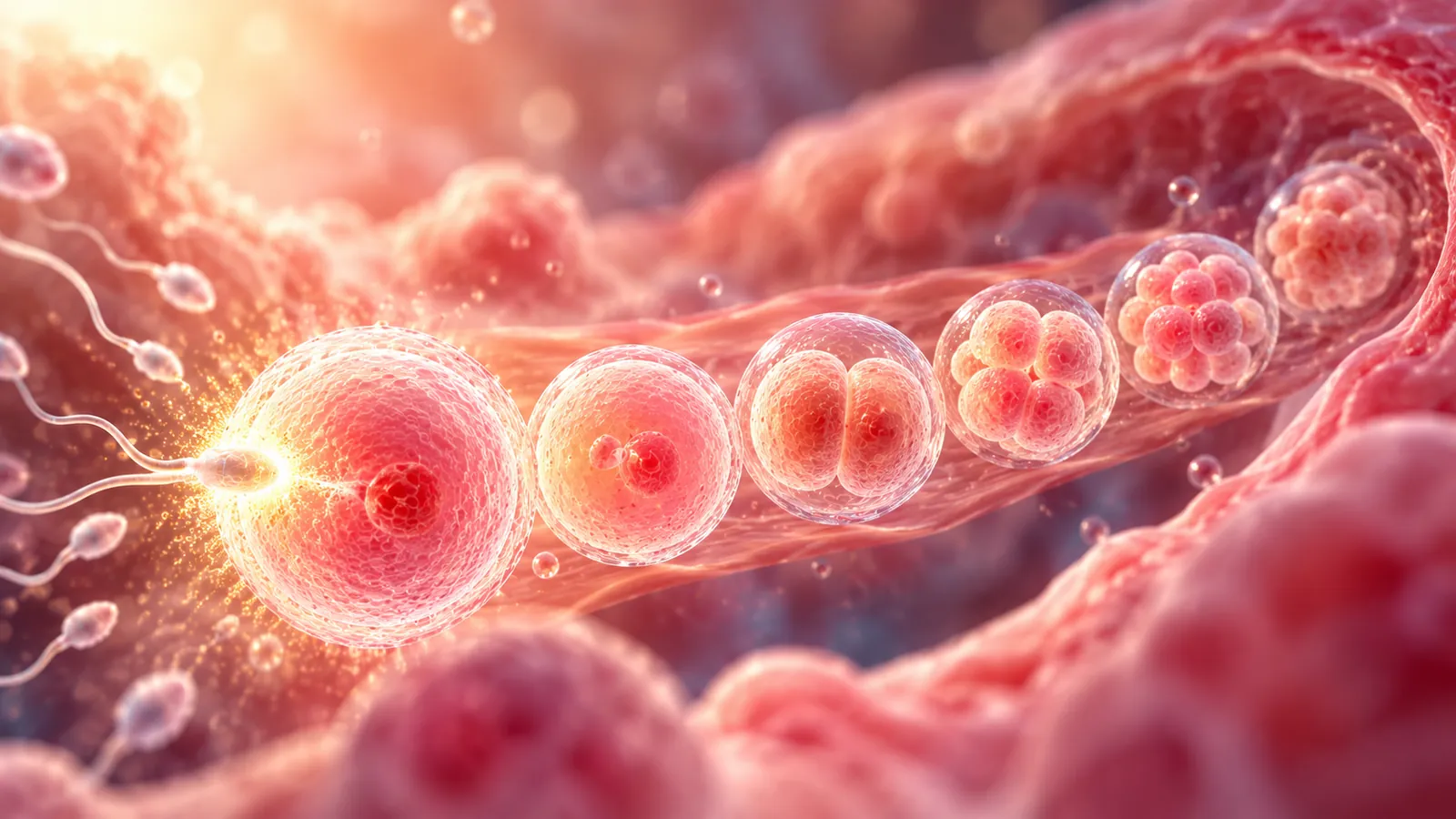
3 Weeks Pregnant: The Week You Might Quietly Become a Mother of Two
Last week ended on a cliffhanger. The race was won, and one tiny sperm was pressed against the egg, about to break through.

1 Week Pregnant: The Egg's Story That Began Before You Did
Before the positive test. Before the missed period. Before you even suspected anything had changed, there was already a story unfolding inside your body.
4 Weeks Pregnant: The Week Your Baby Announces Itself
For three weeks, your body has been keeping the most extraordinary secret. This is the week it finally lets you in on it.
Want to keep following your pregnancy week by week?
Track your pregnancy, follow your baby’s development and find support for the questions that come up along the way in The Mama Years.
Open The Mama Years