


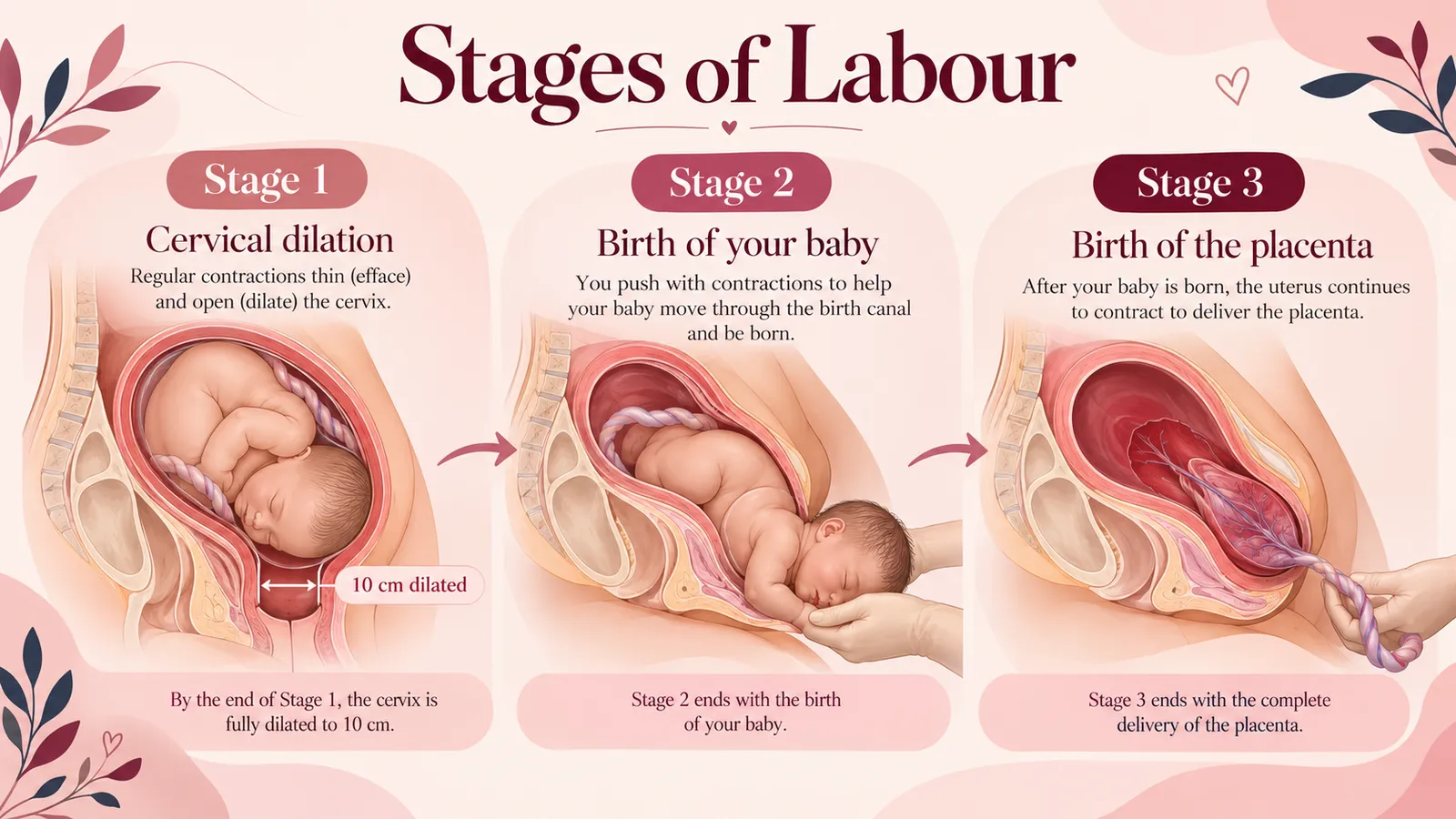
Stages of Labour: What Actually Happens
Understand the three stages of labour, from your cervix opening to pushing, meeting your baby and delivering the placenta.
Reviewed by Courtney Garland, NICU Registered Nurse, IBCLC Lactation Consultant and Paediatric Sleep Consultant
If you're getting ready to have a baby, you've probably heard people talk about the different stages of labour. But what does that actually mean, and how will you know which stage you're in?
Labour is divided into three stages, each describing what your body is doing to bring your baby into the world.
And while these stages are used to describe vaginal birth, how you experience them can be completely different from another mother.
I was induced with all four of my babies, so I never really had that classic moment of contractions slowly starting at home. But my body still went through the same stages, just in its own way.
What happens in the first stage of labour?
The first stage is all about your cervix getting ready for your baby to be born.
It needs to soften, thin out and gradually open to around 10 centimetres. This opening is called dilation.
In early labour, you might notice period-like cramps, lower back pain, a bloody show or irregular contractions that gradually become stronger.
You might still be able to talk through contractions, walk around, eat something and even have a little sleep.
If you and baby are well, this is often a good time to rest and save your energy.
As labour becomes more established, those contractions usually become stronger, longer and closer together.
You'll probably find yourself needing to concentrate more during each contraction rather than carrying on a conversation.
With my inductions, I remember how quickly things could become intense once the contractions really kicked in. It didn't always feel like a gentle build!
What is transition?
Towards the end of the first stage, you may experience something called transition.
This is when your cervix is getting close to fully dilated, and contractions can feel incredibly intense.
You might start shaking, feeling sick, becoming overwhelmed or suddenly thinking, "I can't do this anymore."
Not every woman notices transition, especially with an epidural, but it's helpful to know these feelings can happen.
We've got a separate article explaining what transition really feels like and what can help.
What happens in the second stage of labour?
This is when your cervix is fully dilated and your baby is being born.
You might feel enormous pressure in your bottom, almost like you desperately need to poo.
And yes, that's genuinely what pushing can feel like!
Some women feel their body almost pushing on its own. Others need a little guidance, especially if they've had an epidural.
Pushing might take a few minutes or several hours, depending on your baby, your labour and whether this is your first birth.
We go through pushing in much more detail in Pushing in Labour: What to Expect.
What happens in the third stage of labour?
Your baby is finally here! You might already have them snuggled up on your chest, but there's still one more part of birth left.
Delivering the placenta.
Your uterus continues to contract to help the placenta separate from its wall.
You might feel another contraction or a bit of pressure, and your midwife may ask you to give a gentle push to help it come out.
It usually isn't anything like pushing your baby out!
Your maternity team may also offer you medication to help your uterus contract and reduce the risk of heavy bleeding.
If you've had a caesarean, your placenta is removed during surgery.
And while you're busy meeting your beautiful baby, your team will be keeping an eye on your bleeding and making sure everything is as it should be.
Will my labour follow these stages exactly?
The stages explain what your body is doing, but they don't tell you exactly how long your labour will take.
Some women spend hours in early labour. Others progress much more quickly.
I've had four inductions, and even though they all started medically, they were incredibly different experiences.
So learn the stages, understand what might happen, and remember that you don't have to work out exactly where you are in labour.
That's what your maternity team is there to help you with.
Read next
• What Transition in Labour Actually Feels Like
• Pushing in Labour: What to Expect
• What Happens Immediately After Birth?
You might also like

What Transition in Labour Actually Feels Like
What does transition in labour feel like? Learn about intense contractions, pressure, emotions and what can help you through it.

Pushing in Labour: What to Expect
What does pushing in labour feel like? Learn about pressure, pushing positions, crowning and why feeling like you need to poo is normal.

Instrumental Birth: Forceps and Vacuum
Why might forceps or vacuum be needed? Learn what happens during an assisted vaginal birth, what to expect afterwards and how recovery can feel.
Getting ready for birth?
Follow your pregnancy to the very end, get ready for labour and birth, and find support for the questions that come up along the way in The Mama Years.
Open The Mama Years